

Q2 2026 Review: Great Expectations
7/22/2026
In our first quarter letter, we were careful not to gloat about our strong relative performance. We discussed things worth worrying about, like global instability and war, stubborn inflation, AI FOMO, and a hot IPO market. These risks still exist today, but we also said timing the market is a loser’s game.
The second quarter was a useful reminder of that. The S&P 500 returned 15%, its best quarter since the initial covid bounce in 2020. The underlying risks did not disappear. What changed were investors’ expectations.
Great expectations have returned.
AI (Re)takes Center Stage
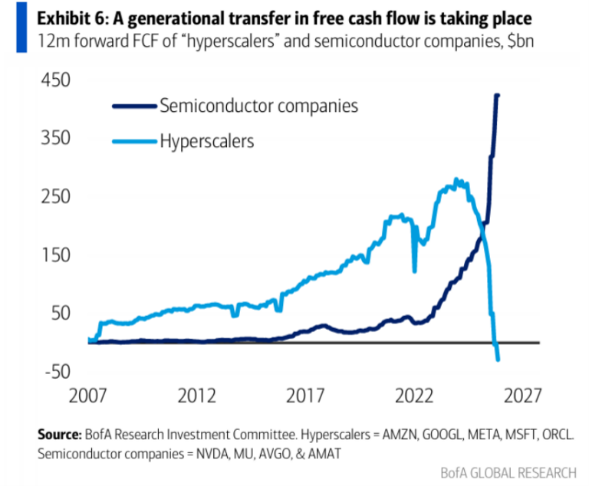
AI resumed its market leadership during the quarter, but the trade migrated downstream. During the first stage of the AI rally, investors rewarded big tech or “hyperscalers” because they appeared to own the platforms, the customers, the data, and had all the money. Now, as the hyperscalers move towards negative free cash flow, investors are rewarding the businesses selling them chips, memory, networking equipment, and power infrastructure.
According to Empirical Research Partners, a relatively small group of AI spending beneficiaries produced 85% of the market’s return through June of this year.
If projections are correct, AI capital expenditures could approach $1 trillion next year, rivaling the scale of national defense spending. With debt and other forms of external financing becoming a larger part of the equation, the durability of this boom will increasingly depend on evidence that this unprecedented investment can produce not only near-term revenue growth, but attractive long-term returns on capital.
Changing of the Capital Cycle
This is a familiar pattern in capital-intensive booms. High growth and rising valuations attract competition, which attracts more capital, which eventually creates excess capacity. For years, big tech’s asset light business models generated abundant free cash flow for share repurchases. Today, much of that cash is being directed toward AI investment, while debt and equity issuance bring even more capital into the race. This pattern repeats throughout history, from railroads to telecom, and there is little reason to believe AI will be any different.
One of the stranger consequences is now showing up in the indexes themselves. During FTSE Russell’s June reconstitution, yesterday’s growth companies moved sharply toward the value index, while semiconductor and AI-infrastructure companies replaced them in the growth index. Amazon moved from 73% growth to 92% value, while Microsoft and Apple went from entirely growth to roughly half value. Together, the Magnificent Seven constitute 17% of the value index, from nothing at the end of May 2025.
Meanwhile, Micron, AMD, and Applied Materials are now classified entirely as growth. Even Caterpillar, one of the most cyclical companies in the market, is a growth stock.
Now before we go loading up on Amazon, Apple, and Microsoft, it’s not as if they’ve turned into traditional value stocks. Instead, the definition of growth has moved around them. The real irony is that index investors no longer have much choice between the two styles. The growth index leaders depend on the value index leaders to keep spending, and although they are two different indices, they are increasingly two sides of the same trade.
No Expectations
So while expectations are being adjusted higher throughout the AI supply chain, there are still large parts of the market where investors expect very little. Few areas illustrate this better than housing, where mortgage rates above 6.5% suppress affordability and transaction volume. As a result, companies such as Eagle Materials, Pool Corp, and Rocket Companies have lagged despite durable long term demand drivers in their respective markets. While the timing of a housing recovery is unknowable, the structural shortage of four million homes is not going away.
Low expectations are not limited to housing. Greg Abel took the helm at Berkshire Hathaway in January, and the market has been slow to warm to the transition. That hesitation looks like an opportunity. With $400 billion of cash and $300 billion of marketable securities, the current valuation appears to assign only a modest value to Berkshire’s collection of operating businesses like BNSF Railway, Berkshire Hathaway Energy, Geico, Precision Castparts, and Clayton Homes. Abel has meaningful room to improve those businesses while deploying Berkshire’s war chest through share repurchases and acquisitions.
Just having low expectations does not eliminate risk, but it leaves considerably more room for positive surprises, particularly when paired with disciplined capital allocation, rising free cash flow, and a falling share count.
Managing Expectations
There is one more expectation that investors may need to reconsider. The Federal Reserve has a new sheriff in town with the recent appointment of Kevin Warsh. In his first press conference, Warsh offered an honest assessment of the Fed’s recent performance. Inflation has remained above its 2% target for more than five years, and the central bank has not delivered the price stability it promised.
Warsh also appears determined to move the Fed out of the spotlight. Investors have grown accustomed to dissecting the Fed’s every word and assuming that market volatility will be met with lower rates and easier monetary policy. Warsh believes markets function better when they react to economic conditions, rather than guessing the Fed’s next move.
That represents an important shift. Much of today’s enthusiasm rests not only on extraordinary growth expectations, but also on the assumption that abundant capital and supportive monetary policy will remain available. If the Fed becomes less accommodative, valuations built on cheap money may carry even more risk than the market is pricing in.
Of course, nobody, including the Fed, has a crystal ball, but with great expectations comes great responsibility. Many investors will continue chasing today’s hot IPOs and AI momentum stocks, often using margin, options, and leveraged ETFs to amplify their exposure. They may even be rewarded for doing so, at least for a while longer.
Our responsibility is different. It is to help clients grow and protect their assets through full market cycles, not chase every last dollar of upside. Sometimes that means accepting a good enough return, rather than getting caught up in the moment. In this environment, it means remaining conservative, broadly diversified, and focused on investments where low expectations and capital discipline leave room for attractive long term outcomes.
Compass Wealth Management LLC is a SEC registered investment advisor, clearing transactions primarily through Pershing Advisor Solutions and Pershing LLC subsidiaries of Bank of New York Mellon Corp. This letter is written by Compass for the benefit of its clients and does not necessarily represent the opinions of its affiliated organizations. It is based on information believed to be reliable, but which is not guaranteed to be correct. Nothing herein shall be construed to be a solicitation to buy or sell securities, indicate that past performance is predictive of future returns, or recommend individual investments.
Contact Compass
PHONE
(203) 453-7000
info@CompassWealthManagement.com