

The Future of College
9/18/2026
The Compass team has at least seven children expected to attend college in the next twenty years. If you include our clients’ kids and grandkids, that number easily exceeds one hundred.
So, we spend a lot of time thinking about saving for college. On the surface, the headline numbers today are so astronomically high that it is daunting to even consider what college will cost in five years, let alone two decades from now. According to Princeton Review, there are sixteen schools with an estimated “all in” cost over $100,000. Multiply that by four (or more) years and multiple children, and you might have to mortgage your home to pay for college.
How is this sustainable?
In short, we don’t believe it is, and the data largely support this view.
With prices so high, it is easy to assume that college costs are rising far faster than the broader economy. According to the College Board, this was true during the 20-year period from 1995-2015, where costs increased roughly three percentage points per year faster than broad inflation rates. As we know from investing, 3% compounded over two decades makes a huge difference!
But over the past decade, cost increases have roughly matched broader inflation, and at many schools, the amount collected after discounts and scholarships has begun to decline. According to a survey of private nonprofit colleges by NACUBO, the average undergraduate discount rate reached 51.3% of tuition in 2025, up from 43.2% a decade ago.
Clearly, something has changed.
Syracuse University offers a useful glimpse of what that change looks like in practice. A recent WSJ article details the pressures facing the school. We know a lot of Cuse grads, (including family) so please don’t be mad, but some combination of a ~$98,000 all in cost, lousy weather, mediocre sports, and a 50% drop in international enrollment has taken a toll. Only 21% of students pay full price, and 1 out of every 2 applicants is accepted. The result is a 1.5% budget deficit, alongside significant new debt for fancy facilities and dormitories it hopes will attract more students.
This dilemma is happening across the country.
Demographics aren’t helping, with the number of high schoolers graduating projected to fall by 13% over the next 15 years, according to the Western Interstate Commission of Higher Education. Include the nearly $2 trillion of student loans outstanding, and it’s fair to question the sustainability of the whole higher education model.
This is all before we even mention how Artificial Intelligence is going to change the education system or what the value of a college degree is in a world with ever more powerful computers. Although there are still too many unknowns about AI to draw any conclusions, the power of these tools will inevitably reshape the labor market over time.
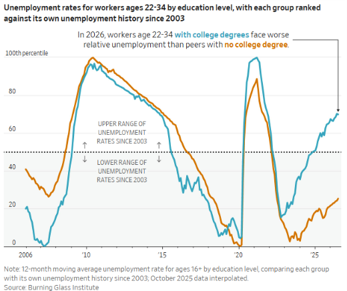
It may already be showing up in the data. According to a recent study by the Burning Glass Institute, the unemployment rate for college educated individuals between 25 to 54 continues to be much lower at 2.7% versus 4.7% for those with a high school diploma. However, as seen in this graph, the relative rate of improvement among non-college educated individuals is quite stark. This could be a short-term phenomenon because of the AI build out and need for tradespeople or the pressures caused by Trump’s immigration policies, but it’s certainly worth keeping an eye on.
We may not know exactly how these forces will reshape the labor market, but we do know that the economics of education are changing. That raises two important questions: what happens next, and how should families prepare?
What happens next?
There are roughly 3,200 public and nonprofit degree-granting institutions in the U.S, not dramatically different from a generation ago. That’s going to change.
The crown jewels of higher education, including the elite universities and strong public flagships, will remain in high demand. The combination of prestige, networks, resources, and scarcity will continue to command a premium. On the other end of the spectrum, we expect trade schools, apprenticeships, and other skills-oriented programs to continue gaining share.
The challenge will be for schools caught in the middle. Like many industries reshaped by technology, higher education may increasingly reward institutions that are either large and scaled or clearly differentiated. This will force difficult decisions around academic programs, staffing, facilities, and athletics (that’s a whole other discussion for another time). In some cases, schools will be forced to close their doors.
While all of this is going on, colleges will need to keep their classrooms full to remain viable. The good news is that schools have two fundamental levers to pull: make the product more attractive or make it less expensive. Either one improves the return on investment for students, but the economics may ultimately require both. As an example, Quinnipiac University is advancing a three-year bachelor’s degree to reach a new subset of students, even though it means giving up a year of tuition revenue.
How to prepare for this future:
Obviously, this is all projection based on a few pieces of data and a technological revolution that can’t even figure out what it’s going to be next week, let alone a decade from now. So, for now, the best approach is simple: save consistently and keep an open mind.
We know intimately that kids are expensive but do the best you can to budget and save. Automate contributions, so you don’t have to make a decision every month. Take advantage of the tax benefits offered by 529 college savings accounts and consider taxable investment or custodial accounts rather than letting long term savings sit in cash. Most importantly, don’t get overwhelmed by today’s headline numbers. Commit to a reasonable savings plan and adjust as the world changes.
Remain open-minded about what comes next. We loved our college experiences, but there are more ways than ever to learn, build skills, and gain valuable life experiences outside the traditional four-year path.
Encourage entrepreneurship, internships, apprenticeships, creativity, and real world experience. In certain parts of the country it may still feel sacrilegious to consider anything other than college immediately after high school, but alternative paths exist, and a changing world may make many of them increasingly attractive.
The bottom line is save diligently, remain flexible, and give the next generation enough resources to choose the path that gives them the best opportunity to learn, grow, and build a fulfilling life.
Compass Wealth Management LLC is a SEC registered investment advisor, clearing transactions primarily through Pershing Advisor Solutions and Pershing LLC subsidiaries of Bank of New York Mellon Corp. This letter is written by Compass for the benefit of its clients and does not necessarily represent the opinions of its affiliated organizations. It is based on information believed to be reliable, but which is not guaranteed to be correct. Nothing herein shall be construed to be a solicitation to buy or sell securities, indicate that past performance is predictive of future returns, or recommend individual investments.
Contact Compass
PHONE
(203) 453-7000
info@CompassWealthManagement.com