

Q3 2026 Review: Memory Lane
10/22/2026
Since the start of the year, the 10-year Treasury has risen from 4% to over 5%, oil from $60 to $100 a barrel, and mortgage rates from 6 to 7%. None of that is good news for consumers, but it hardly seems enough to explain the University of Michigan Consumer Sentiment Index falling to one of the lowest readings in its 75-year history.
There are a few explanations. Housing affordability is awful, with many young people feeling home ownership is completely out of reach. Inflation still hasn’t been tamed and is showing signs of reacceleration. Wars in the Middle East and Ukraine continue to smolder, and to rub salt in the wound, many are concerned about Artificial Intelligence and what it could mean for the future of work.
None of that would lead you to believe that the stock market ended the third quarter up 2%, near all-time highs. But the headline index obscures the anxiety showing up beneath the surface.
It’s increasingly clear that the S&P 500 hinges on one thing: demand for Artificial Intelligence, from chips and data centers to leading AI models and power generation, continuing to outstrip supply. Nobody knows how long this will continue, but we have seen a version of this movie before.
Memory Lane
Compass was founded in March 1997, perhaps the worst possible time for a value manager to take a chance on themselves. In the lead up to the tech bubble, the S&P 500 and Nasdaq went up 33/21% in 1997, 28/39% in 1998, and 21/86% in 1999. The average Compass account significantly trailed the market during that stretch. Although it would have been easier to chase the .com stocks like Pets.com, the big tech companies like Cisco and Sun, or the infrastructure layer through Lucent and WorldCom, we held out.
Eventually, the final dollar dried up. When the bubble burst, many value managers, including Compass, had some of their best years. That experience is hard not to reflect on today but today is not 1999. Many of today’s market leaders are extraordinarily profitable companies, demand for AI infrastructure is real, and the technology may ultimately prove every bit as transformative as investors expect. Plus, unlike 1999, you can find a headline almost every day warning that the bubble is about to pop.
That said, many of the characteristics of the late 1990s are present: a revolutionary technology, extraordinary excitement about its potential, massive capital spending increasingly funded by debt and circular financing, and a willingness to extrapolate today’s growth far into the future.
History often rhymes, but it’s nearly impossible to predict when a cycle will turn or how the market will respond. Our job is not to call the top, but to keep asking if we are comfortable with the assumptions and risks embedded in a stock’s price. Fortunately, there are several sectors where we are comfortable with the risk/reward trade off. They just aren’t where most of the capital is flowing today.
Market Breadth
At the end of the quarter, more than 40% of the S&P was trading in a bear market, or 20% below its 52-week high. Only 2 of the 11 S&P 500 sectors outperformed the index: technology, driven largely by AI, and energy, helped by higher oil prices. Every other sector trailed the market, while consumer discretionary, utilities, communications, and financials are negative on the year. The charts below show just how unusual the divergence has become.
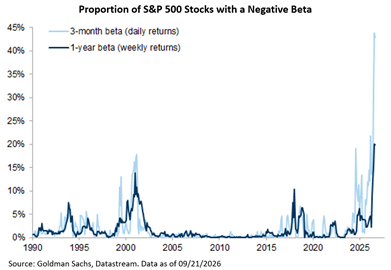
The first measures the percentage of stocks with a negative beta, meaning they have tended to move in the opposite direction of the market. Today, ~45% of stocks have a negative beta. Put simply, over this period, when the market went up, 45% of stocks tended to go down.
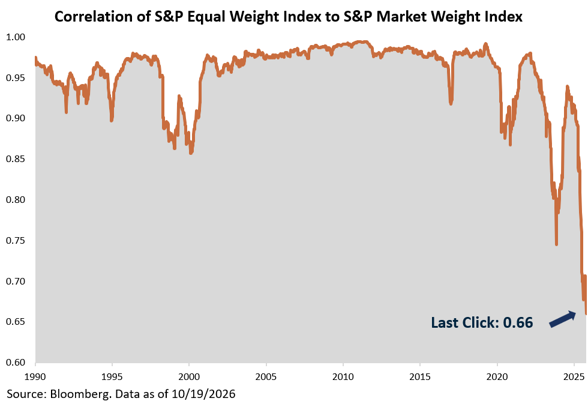
The second compares the correlation between the market-cap weighted S&P500 with the equal-weighted version. The correlation between the two has fallen to its lowest level since the equal-weighted index was created, making the headline index increasingly unrepresentative of the average stock.
Market Concentration
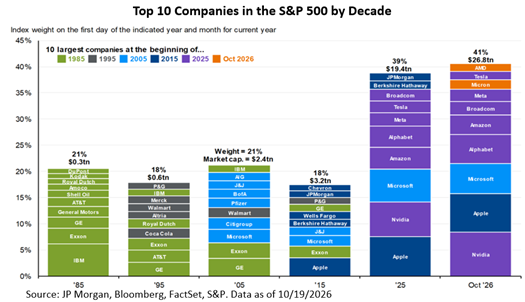
The reason the index is masking so much weakness is concentration, with the 10 largest companies accounting for 41% of the S&P 500. Nearly all are either directly participating in the AI buildout or are expected to be major beneficiaries of it.
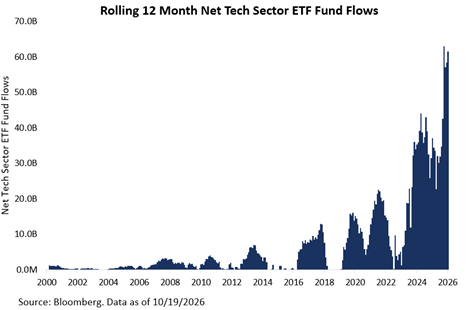
Investors are following the market’s lead. Flows into technology sector ETFs have reached record levels with State Street reporting that technology captured 78% of all sector inflows last quarter.
Household Wealth
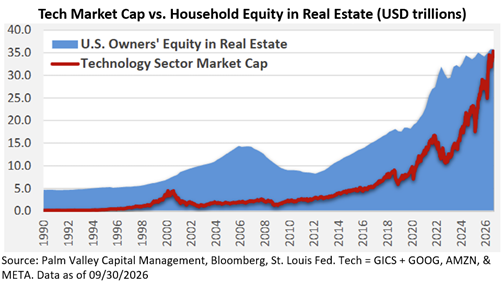
The concentration is no longer just a market statistic. The surge in technology stocks has also had a very real impact on household wealth. In fact, the market cap of the GICS technology sector, plus Alphabet, Amazon and Meta is now roughly $35 trillion, recently surpassing the total equity American households have in their homes. Even at the peak of the tech bubble, technology market capitalization remained well below homeowners’ equity. The comparison is not perfect, but it illustrates just how important technology stocks have become to Americans’ wealth and retirement savings.
A Cost of Capital
Taken together, this is a crowded trade with weak market breadth and an increasing share of wealth concentrated in a technology sector undergoing revolutionary change. That combination alone makes us lean cautious. The real kicker is that this is all happening in a world where capital is no longer free. The scale of the AI buildout is enormous, with companies across the ecosystem racing to add capacity using cash flow, debt and equity. That spending assumes extraordinary future demand, and if returns on all that new capacity disappoint, the question becomes how long investors will keep funding the next round.
That’s why the cost of that capital is becoming harder to ignore. The lowest-rated junk bonds now yield 17%. Even CoreWeave, a poster child for the AI buildout, has bonds yielding 15%. Real estate and private equity are also adjusting to higher borrowing costs, as defaults increase alongside lower return expectations. When enormous amounts of capital are required, and significant debt is involved, the risk is that eventually the final dollar dries up.
The flip side is that this is very good news for savers. Investors can earn attractive returns in high-quality fixed income without taking significant duration or credit risk. We are currently buying short-term, investment-grade bonds yielding between 5.5% and 6%, and we’ll keep buying if yields go higher. For investors willing to wait, patience can earn a return again.
The Benefit of Patience
In our Spring 1999 quarterly newsletter we wrote, “We were absolutely sure that the first quarter of this year would finally mark a shift away from the narrow, mostly tech related market leadership that has been the defining characteristic of the market for the past few years. It didn’t happen. Instead, the market’s leadership narrowed even further with just fifteen stocks making up the entire move in the S&P 500, and those fifteen were the most expensive. The headlines blared ‘VALUE IS DEAD’…‘NO HOPE FOR SMALL CAPS’…‘BIG CAP GROWTH WINS AGAIN’.”
It was another year before the tech bubble popped. The hardest part of investing through periods like this is that patience rarely feels rewarding in real time. When a narrow group of stocks continues to rise, discipline can look a lot like stubbornness, and the third quarter of this year was a reminder of that.
We do not know when the current cycle will turn, and we have enough humility to recognize that trying to predict the exact moment is not particularly useful. What we do know is that price and valuation ultimately matter, and today some of our favorite companies and industries are selling in the bargain bin. Fortunately, the investment menu is much broader than the index would suggest, and recent weakness creates prices we find increasingly attractive.
The country is structurally short housing, even as inventory rebuilds and prices adjust across much of the US. Great consumer brands will continue to matter as technology reshapes how products are discovered and sold. Real-world assets like pipelines will become increasingly valuable as the world reindustrializes and supply chains move closer to home.
Robotics is already improving precision in surgery, while the opportunities for innovation in pharmaceuticals are enormous. We began the fourth quarter with news of Option Care Health, one of our healthcare holdings expected to benefit from a growing pipeline of complex therapies, signing an agreement to be taken private at a 30% premium.
We are optimistic that AI’s benefits will accrue to far more companies than just today’s perceived winners, but we are less certain that the economics of spending trillions on the current buildout will ultimately justify the expectations being placed on the companies funding it.
That distinction matters. Among the 10 largest tech companies entering 2000, only Microsoft outperformed the market over the next 2 decades, and it took nearly 20 years for even that to happen. Some of the others disappeared, but most remained successful businesses despite the poor stock performance. It’s a reminder that investors can be right about the technology and even the companies, but still wrong about the price.
That is what makes the temptation to chase the S&P 500 and its increasingly concentrated bet on a winner-take-all future so uncomfortable. As we wrote more than 25 years ago, “There is a time when even good investments become bubbles.” Perhaps this is a bubble, but we don’t expect it to play out like the late 1990s. The setup is different, and excess can work itself out in a lot of ways: prices can fall, earnings can catch up, or investors can simply spend years earning better returns elsewhere. We aren’t waiting for a crash, but we are focused on deploying capital where there is a greater margin for error if expectations disappoint.
Compass Wealth Management LLC is a SEC registered investment advisor, clearing transactions primarily through Pershing Advisor Solutions and Pershing LLC subsidiaries of Bank of New York Mellon Corp. This letter is written by Compass for the benefit of its clients and does not necessarily represent the opinions of its affiliated organizations. It is based on information believed to be reliable, but which is not guaranteed to be correct. Nothing herein shall be construed to be a solicitation to buy or sell securities, indicate that past performance is predictive of future returns, or recommend individual investments.
Contact Compass
PHONE
(203) 453-7000
info@CompassWealthManagement.com